How to write product descriptions that sell (without sounding salesy)
In theory, writing your product description should be easy, right? You just describe what you made and plop it onto your product page. Job done.
The reality often feels much less easy. The blank page is staring at you, the cursor is blinking, and your brain just won't give you anything to work with. It can be really hard to convey what took you hours to make into a few simple sentences that, hopefully, convince someone to buy it.
In this article, I'm hoping to demystify the process of how to write product descriptions that help your customer understand the beauty and magic of your product, and gently guide them to buy into your world. Yes, it's about selling, but it's also about translating your physical objects into language that resonates with your ideal customer, and that represents the care, attention, and labour you put into making it.
Perhaps it helps to think of your individual product pages and description as tiny homepages: It's another opportunity to explain what your unique product is, what it adds to your customer’s lives and why they should invest in it. Let's walk through the process, step by step.
Table of Contents
Why your product descriptions are more than a sales pitch
E-commerce has many benefits, but one of its major drawbacks is that customers don't get a tactile experience with the piece they're buying. They can't hold it, try it, smell it, or taste it. And when you're selling a handmade, made-to-order, or bespoke product — one that's also often priced higher — that can be a real barrier to buying.
Product descriptions, alongside great photography, are one of the closest ways a person can get to that tactile experience, and they have to speak to your customer's imagination and desires. Because your customer is taking a bigger leap of faith — on price, potentially on wait time, and with no reassurance from a big name brand — your product description also needs to build trust.
So how do you build trust with no physical store, and convey the value of what you make? By weaving in stories about your product and brand. Storytelling has gotten a bit of a bad reputation lately, hijacked by tech bros and online hustlers to make something empty feel meaningful, something fake feel real. But we don't have to use it that way. Stories have always helped humans connect and make sense of things, and telling mini stories in your product descriptions does the same for your brand.
In some ways, it's also a representation of your business overall: a way of conveying your making process, values, and ethics, and what makes your products worth investing in emotionally and financially. It can encapsulate the beauty of something crafted by another human being, rather than being a means to an end in the anonymous buying typical of mass-market stores. Once you understand why the stakes are higher, it's easier to see how to write product descriptions that meet them, which is what the next section walks you through.
How to write product descriptions — step by step
Step 1 — Know the “who” and "why" before you start writing
Truly understanding who your customers are and why they are looking for a product like yours is the bedrock of writing evocative product descriptions.
Imagine having a relaxed conversation with someone from your ideal audience. What questions would they ask about your products? What language do they use to talk about what you sell?
Most importantly: what desire, need or aspiration does your product solve for them. What does it give someone in terms of feeling? Comfort, confidence, a gift that feels meaningful, a piece of a tradition?
As trite as it sounds, most people shop emotions, not things and I think this is especially true for more unique, hand-made or bespoke products. Speaking to these more abstract needs is what builds trust and connection with your brand and the objects you make.
Step 2 — Features → benefits, the maker's way
As we saw in step 1, people rarely just care about the functionality of a product, they want to understand how it can make their life better, more beautiful or remedy a problem they have. In other words, they want to know in what ways buying this product will benefit them.
Let’s look at the difference between features and benefits briefly:
Features:what the maker did, like technique, material, process, etc. (this is also important for SEO, more on that later in the article).
Benefits: what the customer gets to feel or avoid, touching on sensory and emotional rewards.
For handmade goods specifically, benefits often lean into meaning and identity, like "no one else has this", rather than pure function, since that's a big part of why people choose artisan products over mass-market ones in the first place.
Let me give you a few examples of how your product’s features might map to a benefit:
Feature: Your wool felt hats are being hand-blocked on vintage wooden forms
Benefit: Timeless shape that holds its structure season after season, come rain or shine
Feature: Your small-batch hot sauce is fermented with wild, locally grown chilies
Benefit: A flavour you can't find on any supermarket shelf
Feature: Your hand-knitted scarves are made from ethically sourced merino wool
Benefit: Wrap yourself in something warm that supports small farms
Feature: Your hand-poured candles all have a cotton wick
Benefit: Fills your whole room with a clean, even burn. No black soot on your walls.
Step 3 — Format for scanning
With people ever short on time and attention spans equally diminished, it is important to make sure that your product descriptions are well structured and easy to read.
Engage your customers with a vivid opening sentence and lead with the most important details first
Use clear headings for sections so customers know what to expect
Steer away from rambling paragraphs, keep it short and to the point
Leave plenty of white space to help guide the reader’s eye
Make sure your font is set to an easily readable size and has enough contrast against the background (super important for accessibility as well!)
Use bullets (or a collapsible accordion block) for the practical things like sizing, dimensions, care instructions, etc. at the end, to condense information and help avoid overwhelm for the reader
Step 4 — Answer the questions a hesitant buyer has
Part of learning how to write product descriptions that convert is knowing which hesitations are costing you the sale.
For handmade, made-to-order, and bespoke goods, addressing these questions head-on is especially important and helps with SEO too (more on that below). Every hesitation you answer inside the description is one less reason for someone to close the tab and not come back.
Here are a few of the most common points that you might want to address:
Fit or sizing (you could also link to a pop-up sizing table or a fit guide on a separate page)
Care and durability (explain in simple and clear language how best to take care of the piece to ensure longevity. Try to use common terms where applicable, e.g. “dry clean only”, “hand wash cold”)
Timeline (while the type of person who buys an artisanal or handmade product is likely fine with waiting a longer time for their purchase, it is best practice to communicate timelines honestly and clearly)
Returns and exchanges (especially important to clarify when something was made to order, customised or bespoke)
Value (this will depend on the type of product you sell and at what price point, but it can be reassuring for customers to have some background on why an item has the (monetary) value it has. Perhaps the type of material you use is very rare or the techniques applied are incredibly labour-intensive, whatever it is that lifts your product above a mass-market item)
Weave the answers straight into the same bullets or accordion block from Step 3, so customers don't have to go hunting for reassurance.
Usually a line or two is plenty: "Runs slightly large, order down if you're between sizes", "Handmade to order, ships in 2–3 weeks" But if your product is made to order or one of a kind, some of the questions require more in-depth answers. Let’s look at those next.
Step 5 - Writing for made-to-order, bespoke, and one-of-a-kind products
Made-to-order. The time it takes to make your products is nothing to apologise for. On the contrary, I believe this is one of the aspects that makes your small business stand apart from the Amazons of the world. State the timeline plainly, and if you can, tie it back to the value: hand-cut, hand-stitched, only made once someone orders it rather than just pulled off a shelf. A customer who understands why something takes time is a far more patient customer than one left guessing.
One-of-a-kind or limited pieces. The balance to strike here is writing a description you can reuse across your range to some degree, while teasing out each piece’s individual charm. Describe the qualities that repeat: the technique, the materials, the feeling the piece gives someone, and then layer in what makes it one-of-a-kind (e.g. "each piece is hand-thrown and individually glazed, so the pattern on your bowl will be unique to your piece").
Bespoke and customisable. Here, we want to focus on showing someone the range of what's possible without overwhelming them. List the broad categories of choice, size, colour, finish, rather than every possible combination, and give customers a clear, low-pressure next step: "book a fitting," "get in touch to customise." The aim is to invite a conversation about the product that will eventually guide your customer to place an order.
Hybrid offers. If part of what you sell is tied to an experience, say, a studio visit, a workshop, a class, the same thinking still applies to writing the description. What will someone walk away with? What will they feel, learn, or make?
Picture two listings from the same small candle studio. A ready-to-ship candle focuses more on the availability: order today, in your home in a few days. The listing for a made-to-order, custom-scented version needs to tell a little more: explain the wait time, share the process, lay out the vessel and scent choices simply and clearly.
With your descriptions doing the work of answering hesitation and building trust, the last piece is making sure the right customers find your products in the first place.
SEO for product descriptions, explained simply
Search Engine Optimisation (SEO) deserves its own article, but since it's also relevant here, here's a brief overview of the most important aspects to pay attention to when it comes to SEO for product descriptions.
What a keyword actually is
A keyword is simply the words a real customer would type into Google (or an AI tool) when they're looking for something like what you make. If you sell mugs, that could be "hand-thrown ceramic mug”, for example. Beware of just assuming the way you think and talk about your products is automatically the way your ideal customers do as well.
Knowing how to write good product descriptions starts with knowing how your customer actually talks about what they want (see also Step 1 above). Go through your own past customer messages, reviews, or even a friend's off-the-cuff description of your product. That can give you a really strong idea of what your keyword(s) should be. And if you’d like to hire an expert for that, I am happy to recommend some trusted SEO service providers.
Where to actually place keywords
You don't need to sprinkle keywords everywhere. Just start by covering these main spots:
Meta page title (this is the clickable headline shown in search results and browser tabs)
Meta page description (the short summary of the page shown under the title in search results)
Product URL (e.g. www.yourwebsitename.com/hand-thrown-coffee-mug)
Product title
The first sentence or two of the product description
Frequently asked questions (for more background, see also Step 4 above)
The image alt text (the short line describing an image for screen readers and search engines alike)
These elements signal to search engines what search intent — the main goal or purpose a user has when typing a query into Google — the page's content answers. Get your main keyword into those places naturally, and you've covered the essentials.
Don’t keyword stuff
While keywords are important, you don’t want to go overboard and shoehorn them into every possible place in your product descriptions. That tactic is called keyword stuffing and search engines have become very good at spotting it. Google will penalise you by ranking your website lower in search results or could even ignore your content entirely.
Here’s an example of keyword stuffing:
Are you looking for a hand-made ceramic mug? Then this hand-made ceramic mug is perfect for you. We create the most unique hand-made ceramic mug and are proud that all our hand-made ceramic mugs are made locally here in Edinburgh.
In a nutshell, you want product descriptions that sound human, not like they’ve been built around “gaming” the system.
What about AI powered search?
A well-written, SEO optimised product description doesn’t just help you show up in a Google search. The same clear, keyword-optimised, human writing also helps you surface in AI-powered search and shopping tools, since those tools are reading your website too and scan those important page signals mentioned above (page title and description, product title, etc.).
What to do if you sell on multiple platforms
If you sell on multiple platforms, for example Etsy and your own Squarespace website, be mindful of pasting the same description across all places you sell. It might seem efficient, but duplicate content can actually work against you, and different platforms tend to reward slightly different things. An Etsy shopper browses differently than someone landing on your own site through a Google search. Give each platform its own version, even if the bones of the description stay the same.
Example: Turning a handmade product into a product description that sells
Theory only gets you so far. So, let's put everything into practice with an example product: a hammered brass statement cuff, made in layered, rib-like bands that catch the light from every angle.
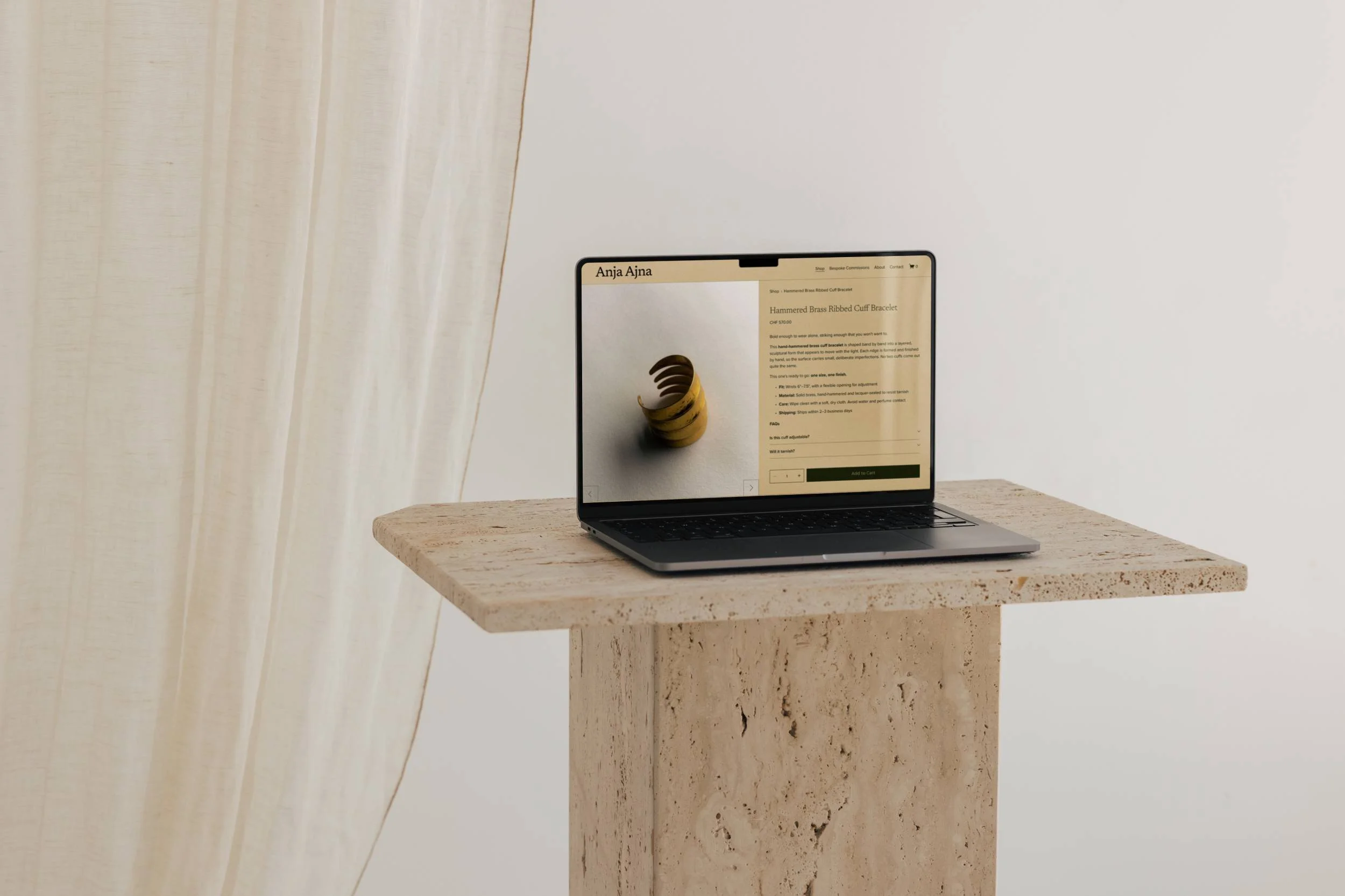
Hammered Brass Ribbed Cuff Bracelet
Bold enough to wear alone, striking enough that you won't want to.
This hand-hammered brass cuff bracelet is shaped band by band into a layered, sculptural form that appears to move with the light. Each ridge is formed and finished by hand, so the surface carries small, deliberate imperfections. No two cuffs come out quite the same.
This one's ready to go: one size, one finish.
Fit: Wrists 6"–7.5", with a flexible opening for adjustment
Material: Solid brass, hand-hammered and lacquer-sealed to resist tarnish
Care: Wipe clean with a soft, dry cloth. Avoid water and perfume contact
Shipping: Ships within 2–3 business days
FAQs
Is this cuff adjustable? Yes — it has a flexible opening so it fits most wrists between 6" and 7.5".
Will it tarnish? The lacquer seal is designed to resist tarnishing with normal wear; avoid water and perfume for best longevity.
SEO
Meta page title
Hammered Brass Ribbed Cuff Bracelet | Ready to Ship
Meta page description
Hand-hammered solid brass cuff bracelet with a layered, ribbed design. One size, ships in 2–3 business days.
URL slug
/products/hammered-brass-ribbed-cuff-ready-to-ship
Image alt text
Image 1 (angled, cuff standing on end): Hand-hammered brass ribbed cuff bracelet standing upright, showing layered band texture
Why this works
The opening sentence is short and striking enough to tell a customer exactly what kind of piece this is before they read on. The next paragraph builds trust by naming the process and turning a product feature into a benefit: a surface that catches light with a texture no machine could replicate. This is also where the keyword lives, with "hammered brass cuff" sitting naturally in the first sentence, right where both a search engine and a curious customer expect to find it. Finally, sizing, materials, care, and shipping all live in a short bulleted list at the end, so the practical details stay easy to scan without crowding the story.
Need a new online home for your products?
Great product descriptions can only do so much if the website around them isn't built to support them. If you're looking for a place that lets your products, and the stories behind them, really breathe, I'd love to chat about how we can build that together. My one-week ecommerce website process includes a content guide with tips and examples of how to write product descriptions (and all the other text on your site), so you're never staring at a blank page.
Frequently asked questions about how to write product descriptions
-
Start with your customer, not your product. Get clear on who they are and what they're hoping this piece will do for them, whether that's comfort, confidence, or a sense of tradition. From there, translate your features into benefits: what your craftsmanship actually gives someone. Lead with a vivid opening line, keep your paragraphs short, and put the practical details (sizing, care, shipping) into a bulleted list at the end. That's really the whole shape of how to write product descriptions that feel personal and still do their job.
-
At minimum: a short, striking opening line, a paragraph that turns your product's features into benefits and tells a small story about how it's made, and a bulleted section covering the practical stuff, fit, materials, care, and shipping timelines. If your product raises specific questions (adjustable sizing, made-to-order wait times), a short FAQ at the end helps too. Think of it as a tiny homepage for that one product: everything a hesitant buyer needs to feel confident, in one place.
-
Lead with your most compelling detail first, since attention spans are short and people are scanning, not reading top to bottom. Use a clear heading if your platform allows it, keep paragraphs to a few sentences, and leave enough white space that the page doesn't feel dense. Save sizing, materials, and care instructions for a bulleted list (or a collapsible accordion block) near the end, so the story stays uncluttered by logistics.
-
It depends on what you're selling. A ready-to-ship item can often get away with a short opening line, one paragraph, and a few bullets. Made-to-order, bespoke, or one-of-a-kind pieces usually need a bit more: enough to explain the wait, the process, and what makes each piece unique. Either way, aim for the shortest version that still answers a hesitant buyer's real questions, rather than a fixed word count.
-
Here's a short one, for a hand-hammered brass cuff:
Bold enough to wear alone, striking enough that you won't want to. This hand-hammered brass cuff bracelet is shaped band by band into a layered, sculptural form that appears to move with the light. No two cuffs come out quite the same.
Followed by a bulleted list covering fit, material, care, and shipping. Short, specific, and led by the piece's most interesting quality rather than a generic pitch.
-
It can be a useful starting point, but it works best as a first draft you then shape into your own words, since your customer's specific language and your product's real story are what actually build trust. Worth knowing too: the same clear, well-organised writing that helps you rank in a Google search also helps you surface in AI-powered search and shopping tools, since they're reading the same signals on your page. So the effort you put into writing this well pays off in both places.
-
Work out your keyword first: the actual words a customer would type into a search engine, not the words you use internally to describe your own work. Then place it naturally in your meta page title, meta description, product URL, product title, the first sentence or two of your description, your FAQ, and your image alt text. That covers the essentials without needing to repeat it everywhere on the page, which starts to feel forced and can actually work against you.
-
Start with the groundwork: know how your customer actually talks about what you make, not just how you talk about it yourself. Past customer messages and reviews are a good place to find that language. From there, get your keyword into the key spots on the page, avoid stuffing it in everywhere, and if you sell on more than one platform, write a separate version for each rather than pasting the same description across all of them. Duplicate content tends to work against you, and each platform's shoppers browse a little differently anyway.